Ordering food at a warung is usually a short, practical exchange. A warung is a small, traditionally family-run eating place in Indonesia, including Bali [1]. The basic pattern is simple: greet the person serving you, name the dish or point to it, say how many portions you want, and add only the changes you need [1]. The phrases below are enough for many everyday orders, though practice varies by region and type of warung.
Start with the basic pattern
The most useful structure is a greeting, the dish, the quantity, and a softener. For example, Saya mau pesan nasi goreng satu means ‘I’d like to order one fried rice’ [1]. In a casual warung, a shorter version is common: Bang, nasi goreng satu ya — ‘Bro, one nasi goreng, please’ [3]. The word ya at the end softens the request; it does not change the quantity.
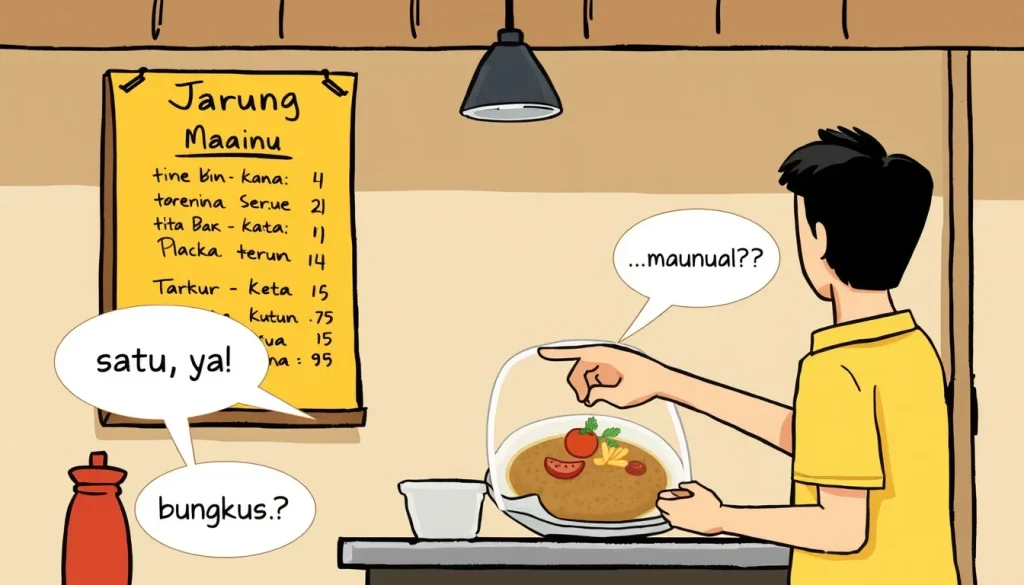
Permisi is a gentle way to get attention or pass by [1]. Tolong means ‘please’ and can be added to a request [1]. If the food is already displayed, point and ask Yang ini apa? (‘What is this one?’), then say Satu, ya (‘One, please’) [1].
Useful words and phrases for a warung order
The table below groups the expressions by the part of the order they handle. Pronunciation is not given because Indonesian spelling is relatively regular; the main point is to keep each request short and handle one detail at a time [1].
| Phrase | Meaning | When to use it |
|---|---|---|
| Permisi | Excuse me; may I have your attention | To start an order gently [1] |
| Saya mau pesan … | I would like to order … | More textbook-like; still understood [1] |
| … satu, ya | One …, please | The most common shortened order [1][3] |
| Yang ini apa? | What is this one? | For pointing at displayed food [1] |
| Bungkus | Takeaway | Often heard in ‘Bungkus atau makan di sini?’ [2] |
| Makan di sini | Eat here; dine in | Answer to the takeaway question [2] |
| Lauknya apa? | Which side dishes? | Server asks what to add [2] |
| Mau sambal? | Do you want sambal? | Server offers chili sauce [2] |
| Mau minum apa? | What would you like to drink? | Common drink question [2] |
| Ada …? | Do you have …? | Ask about availability [2] |
| Habis | Sold out; run out | Said of a drink or dish [2] |
| Pake … | With … (casual) | ‘Pake telor’ means with egg [3] |
| Gak pake pedas | Not spicy (casual) | ‘Gak’ is casual for ‘tidak’ [3] |
| Tanpa gula | Without sugar | ‘Tanpa’ means without [4] |
Common questions you will hear
Warung staff often guide the order with a series of short questions. The exact wording varies, but the following are common in the sources consulted.
Mau pesan apa?
This means ‘What would you like to order?’ [2]. Answer with the dish and quantity: Nasi campur satu ya, Bu (‘One mixed rice, please, ma’am’) [2]. Bu is a short form of Ibu, used to address a woman politely.
Bungkus atau makan di sini?
This asks whether you want takeaway or to eat on site [2]. Bungkus means ‘takeaway’ or ‘wrapped’; makan di sini means ‘eat here’ [2]. A short answer is fine: Makan di sini [2].
Lauknya apa?
This asks which side dishes you want [2]. Lauk refers to the accompanying dish or dishes, not the rice itself. In the recorded exchange, the answer is Ayam, telur, tahu, tempe, dan sayur — chicken, egg, tofu, tempe, and vegetables [2]. Tempe is fermented soybean cake; it is a common warung food.
Mau sambal?
This asks whether you want sambal, a chili sauce or chili relish [2]. Iya, boleh means ‘Yes, please’ in this context [2]. If you do not want it, a simple Tidak, terima kasih (‘No, thank you’) works, though the sources do not record that exact reply.
Mau minum apa?
This asks what you would like to drink [2]. You can ask about availability with Ada …? (‘Do you have …?’). In the source dialogue, Ada es jeruk? means ‘Do you have orange juice?’ [2]. The reply Jus jeruknya habis means the orange juice has run out; habis is a useful word for ‘sold out’ or ‘run out’ [2].
How to customize an order
Once the basic order is understood, small changes are usually handled with short phrases. In casual speech, pake is a common shortening of pakai, meaning ‘with’ [3]. Pake telor means ‘with egg,’ pake sambal means ‘with sambal,’ and gak pake pedas means ‘not spicy’ [3]. Gak is a casual form of tidak (‘no’ or ‘not’) [3].
Tanpa means ‘without,’ as in tanpa gula (‘without sugar’) [4]. For dietary needs, these phrases help you ask, but they are not a guarantee about ingredients or preparation. If you need to avoid a specific ingredient, confirm it directly with the seller rather than relying on a general phrase.
Formal, casual, and regional choices
Indonesian has a range of registers, and the phrases you use at a warung should usually be short and friendly rather than formal. Source [1] gives the textbook-like pattern Saya mau pesan … (‘I would like to order …’). Source [3] notes that a full sentence such as Saya ingin memesan nasi goreng, silakan sounds robotic in a casual warung, and that locals are more likely to say Bang, nasi goreng satu ya.
For addressing staff, Bang is a casual term for a male server, short for abang, and Mbak is used for a woman [3]. Mas also works for men and is more common in Java, while Bang is common in Jakarta [3]. Bapak and Ibu are more formal; Anda (‘you’) is not used in this casual setting [3]. These are tendencies, not fixed rules, and a polite Bu or Pak is a safe choice when unsure.
A short sample exchange
The following exchange is adapted from a beginner listening lesson at a warung [2]. It shows how the server’s questions lead the order.
- Server: Mau pesan apa? (‘What would you like to order?’)
- You: Nasi campur satu ya, Bu. (‘One mixed rice, please, ma’am.’)
- Server: Bungkus atau makan di sini? (‘Takeaway or eat here?’)
- You: Makan di sini. (‘Eat here.’)
- Server: Lauknya apa? (‘Which side dishes?’)
- You: Ayam, telur, tahu, tempe, dan sayur. (‘Chicken, egg, tofu, tempe, and vegetables.’)
- Server: Mau sambal? (‘Do you want sambal?’)
- You: Iya, boleh. (‘Yes, please.’)
- Server: Mau minum apa? (‘What would you like to drink?’)
- You: Ada es jeruk? (‘Do you have orange juice?’)
- Server: Jus jeruknya habis. Ada es teh, es susu, dan kopi. (‘The orange juice has run out. We have iced tea, iced milk, and coffee.’)
- You: Kopi satu ya, Bu. (‘One coffee, please, ma’am.’)
This is a planning example, not a script that every warung will follow. Some places have a printed menu, some display dishes, and some are more self-service. The value of the exchange is the sequence: order, takeaway choice, side dishes, sambal, and drink.
What to confirm before you order
If there is no menu, point to the food and ask Yang ini apa? [1]. If you want a dish that may be finished, ask Ada …? and listen for habis [2]. If prices are not displayed, ask before ordering; the sources consulted for this guide do not provide current price levels, so no figure is given here. For allergies or strong dietary restrictions, ask specifically about ingredients and preparation. A phrase such as tanpa gula is useful for drinks [4], but it does not cover every need.
The language in this guide is drawn from general beginner and travel-language sources. Warung practice differs across Indonesia, including between Java, Bali, and other islands, and between casual street stalls and more formal eating places. Treat the phrases as a starting point, not as a complete description of every local custom.
Next step
Before a trip, practice the core sequence aloud: Permisi, the dish name plus satu, ya, and makan di sini or bungkus. Keep a translation app or a printed list for specific ingredients, and ask the seller when a detail matters. For broader planning, pair these phrases with a food guide to the region you are visiting and a basic Indonesian pronunciation resource.
FAQ
Do I need to speak Indonesian to order at a warung?
No. Many orders can be completed by pointing and using short phrases such as ‘Satu, ya’ and ‘Yang ini apa?’ A few words make the exchange easier, but they are not a requirement.
What does ‘bungkus’ mean?
‘Bungkus’ means takeaway or wrapped. It appears in the common question ‘Bungkus atau makan di sini?’ (‘Takeaway or eat here?’).
How do I say ‘not spicy’ in Indonesian?
In casual Indonesian, ‘Gak pake pedas’ means ‘not spicy’. ‘Gak’ is a casual form of ‘tidak’.
Is it rude to use ‘Bang’ or ‘Mbak’ at a warung?
These are casual, warm terms for addressing a male or female server at a warung, according to one source. ‘Bapak’ and ‘Ibu’ are more formal; ‘Anda’ is not used in this setting.
Can I ask for no sugar?
‘Tanpa gula’ means ‘without sugar’. It is a useful phrase for drinks, but confirm other ingredients directly if you have dietary restrictions.